Reservation8/10
Rae Lakes Loop permits
One of California's premier backpacking routes—a 41-mile loop through pristine a...
Sequoia & Kings Canyon National Parks · California
Multi-day permits for Mount Whitney, popular for acclimatization.
70% of the openings our scanner caught on Mt. Whitney Overnight were gone within 10 minutes.
Build your full itinerary start to finish
Add your dates and get a day-by-day plan: what needs a permit, what gear to bring, and one link to share with your whole group to coordinate every step.
No permit needed to start
Mount Whitney has several separate permits for different routes and trip lengths. See the Mt. Whitney permit page.
Quota season is May 1 to November 1. Inyo says the trail is usually snow-free from July to late September, and NPS puts the non-technical window at mid-July to early October. Two nights inside that stretch is the most reliable summit plan. Outside quota season permits are unlimited and bookable two weeks ahead, but the route becomes a winter climb.
Trailhead (5,000 ft)
Backcountry Tips
Today
49°
33°
Sun
46°
28°
Mon
48°
28°
Tue
48°
27°
Wed
48°
26°
Thu
49°
28°
Fri
51°
30°
Sign up at Recreation.gov if you don't have an account. Verify your email and add payment info ahead of time.
Submit your application between February 1 and March 1. Apply for multiple dates to increase your odds.
Results are typically announced March 15. Check your email and your Recreation.gov account.
Permits get cancelled daily. Peak cancellation times are 24-48 hours before the trip date.
Get notified when cancellations happen. Pro and $19 single-permit alerts are checked about every minute, 24/7; free accounts are checked hourly.
Quota season opens May 1, but NPS says ice axes and crampons are needed in spring and early summer.
Fitness and endurance required
Climbing, scrambling, or specialized skills
Steep dropoffs and fall potential
Route finding and trail clarity
Difficulty of bailing out mid-route
Backpackers who want the summit with a night at altitude built in, and John Muir Trail hikers finishing or starting at Whitney Portal.
Multi-day backpacking and previous nights at altitude. The trail is non-technical when snow-free; the elevation and the weather are the difficulty.
Climbers heading for the Mountaineer's Route or East Face, which the Whitney Trail permit does not cover, and anyone who has not slept above 10,000 feet before.
Mount Whitney's summit is inside Sequoia National Park, but the overnight permit for the standard route is not a park permit. NPS routes hikers by starting point: begin at Whitney Portal on the east side and you apply to Inyo National Forest, cross the Sierra from the west and you apply to Sequoia & Kings Canyon.
The Inyo overnight permit is capped at 60 people per entry day during quota season, May 1 to November 1, and every date in that window goes through the Mt Whitney Lottery — applications February 1 to March 1, results March 15, claim by April 21, unclaimed dates on general sale April 22 at 7 am Pacific.
Camping a night on the way up is Inyo's own advice rather than a workaround. The forest names Lone Pine Lake, Outpost Camp, Consultation Lake and Trail Camp as the usual choices for backpackers who want more time to adapt to the elevation.
The summit belongs to Sequoia National Park, but the permit almost never does. NPS is clear that hikers starting at Whitney Portal apply to Inyo National Forest, and only people crossing the Sierra from the west apply to Sequoia & Kings Canyon. So the overnight permit most people actually need is the Inyo Mt Whitney Trail overnight permit, capped at 60 people per entry day and allocated through the February lottery.
The route is the same 10.7-mile trail NPS describes from Whitney Portal at 8,360 feet to the summit at 14,505 feet, gaining over 6,200 feet. Inyo names the camps that break it up: Lone Pine Lake at 9,900 feet, Outpost Camp at 10,400, Consultation Lake at 11,600 and Trail Camp at 12,000.
Above Trail Camp come the switchbacks — NPS counts 100 of them — to Trail Crest at 13,600 feet, which is where the trail crosses into Sequoia National Park about two miles from the top. From there the summit spur runs 2.4 miles along the west side of the crest, starting a hundred yards below Trail Crest. There is no reliable water between Guitar Lake on the west and Trail Camp on the east.
Park rules take over at the crest and they are stricter than the forest's: no camping in the Mt. Whitney shelter, a two-night limit in the Crabtree and Whitney Creek area and at Guitar Lake, no camping at Timberline Lake, and a maximum party size of 8 rather than 15 in the off-trail areas of Mt. Whitney and Whitney and Crabtree Creeks.
The difference a night makes is not romantic, it is physiological. You get to Trail Camp at 12,000 feet in the afternoon with the switchbacks stacked above you, eat, sleep badly, and wake up already at altitude instead of climbing 4,000 feet into it before breakfast. The people passing you at 3 am left the car at midnight and have another six hours in them before they see the sun.
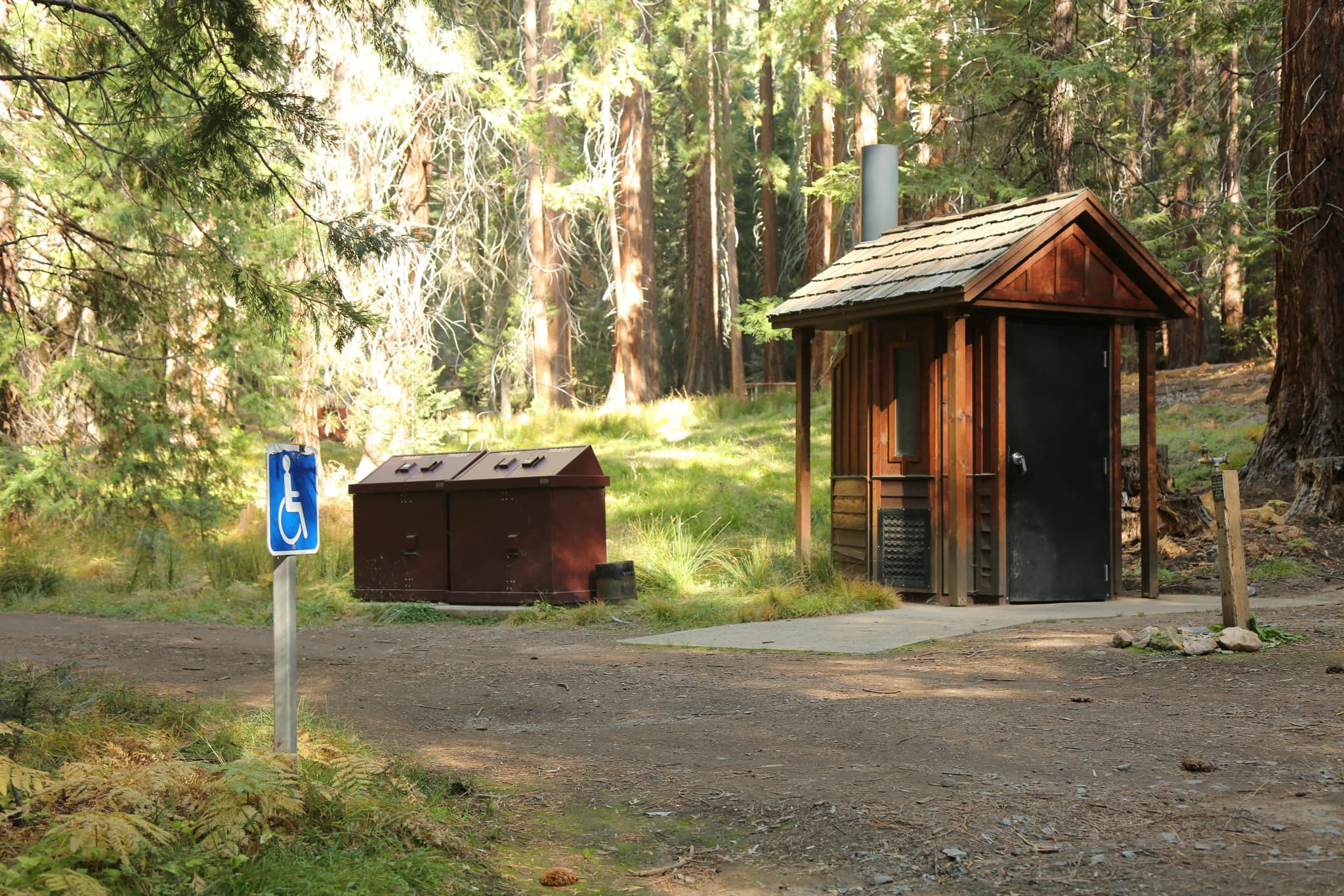
The east-side trailhead for the Mt. Whitney Trail, at the end of Whitney Portal Road. Permits for trips starting here come from Inyo National Forest, not the park.
Parking is limited; Inyo asks people to carpool. Bear activity is high, so all food and scented items must be removed from vehicles and secured in the bear-proof lockers in the parking areas.
Highway 395 to Lone Pine, west on Whitney Portal Road at the town's only traffic signal, about 13 miles to the trailhead.
Lone Pine. The Eastern Sierra Interagency Visitor Center sits 2 miles south of town at Highway 395 and State Route 136 — NPS also calls it the best place from which to see the mountain.
The west-side approach NPS names for reaching Whitney from Sequoia National Park, on a SEKI wilderness permit rather than an Inyo one.
Parking is available at Crescent Meadow or Wolverton. Backpackers with a wilderness permit may access the Crescent Meadow trailhead 24 hours a day.
From Visalia, CA-198 east to the Ash Mountain entrance and on 16 miles to Giant Forest. Vehicles over 22 ft are not advised; in summer approach via Grant Grove and the Generals Highway.
Permits for this entry point are issued at the Lodgepole Visitor Center.
Lottery concierge
Next season’s application dates aren’t published yet.
We check for them every day. Track Mt. Whitney Overnight now and your concierge picks them up the moment they land, then emails you when applications open, before the deadline, and when results post.
Better odds with a crew
Mt. Whitney Overnight is a lottery. Every friend who applies adds another entry, so a crew gets more shots at the same permit than any one of you alone.
One of you runs the pool (Pro or a $19 alert). Everyone else joins free.
Required and recommended gear for Mt. Whitney Overnight
Trailhead transportation options
Browse all shuttlesExperienced wilderness guides
Browse all guidesSome links may be affiliate links. Purchases support PermitSnag at no extra cost to you.
60 people/day, no published rate
estimated success rate
Get detailed lottery statistics and tips. Sign up to track this permit.
Apply with a crew to multiply your combined odds, and let auto win-detection tell you the moment you win — you never have to check Recreation.gov. Win-detection reads the result email you forward us, so it takes a one-time setup in your inbox (about two minutes, and we walk you through it). Pool and auto win-detection are on Pro or a $19 permit alert.
Apply these for the best odds
Opens the official lottery — you submit your entry. We never automate or store your Recreation.gov login.
Full lottery odds & strategy →It depends where you start, and NPS spells it out. "If you begin at Whitney Portal, in Inyo National Forest on the east side of the Sierra Nevada, you should apply for a Mt. Whitney permit from Inyo National Forest." Only if you begin in Sequoia National Park and cross the range from the west do you apply to Sequoia & Kings Canyon. The summit is in the park; the permit usually is not.
60. Inyo National Forest states "60 people per entry day for Mt Whitney Trail Overnight permits," separate from the 100 day-use permits at the same trailhead. Overnight trips approaching by other routes fall under different quotas.
Altitude. Inyo's own description of the overnight permit is that backpackers "often choose to camp one or two nights, allowing more time to adapt to high elevation." A day hike means climbing over 6,200 feet in 12 to 14 hours starting in the dark. The overnight permit also extends onto the John Muir Trail, which the day use permit cannot do.
Inyo names Lone Pine Lake at 9,900 feet, Outpost Camp at 10,400, Consultation Lake at 11,600 and Trail Camp at 12,000 on the east side. Past Trail Crest you are in Sequoia National Park, which prohibits camping in the Mt. Whitney shelter and at Timberline Lake, and limits the Crabtree and Whitney Creek area and Guitar Lake to two nights.
15 on trail under both agencies. But Sequoia & Kings Canyon cuts it to 8 in the off-trail areas of Mt. Whitney, Whitney and Crabtree Creeks, Upper Rock Creek and Mt. Langley, where off trail means half a mile from a trail in overnight areas. Affiliated groups may not travel or camp within half a mile of each other if the combined size exceeds the limit.
Not reliably. NPS says to fill up before the climb from Guitar Lake because "there is no reliable water supply between Guitar Lake and Trail Camp on the east side." Trail Camp at 12,000 feet is the last dependable source coming up from Whitney Portal.
Yes, on the Inyo overnight permit. The forest states it "can also be extended to continue onto the John Muir Trail" if you provide the exit location, exit date and itinerary. One permit covers continuous wilderness travel through adjacent parks and forests, and you follow each agency's rules as you cross boundaries.
No agency publishes a rate, so none is quoted here. The published numbers are the quota — 60 people per entry day — and the lottery calendar: apply February 1 to March 1, results March 15, claim and pay by April 21, unclaimed dates released to everyone at 7 am Pacific on April 22.
No active conditions reported
Sign in to report trail conditions.
Evening at Trail Camp, after the sun drops behind the crest and only the Inyo Mountains across the valley are still lit.
First light from the switchbacks, with the Owens Valley 8,000 feet below still in shadow.
The overnight permit is the crowd strategy. Day hikers leave Whitney Portal between midnight and 4 am and pass the camps in the dark; leave camp at first light and you follow them up and meet them coming down while you still have the summit.
Consider these alternatives if your preferred dates aren't available.
The same summit in a single 12 to 14 hour push, on a 100-person daily quota instead of 60.
A bigger quota in the same lottery, but no acclimatization night and no ability to combine it with anything else.
The west-side approach NPS names: Crescent Meadow to the John Muir Trail in 49 miles, then 13 more to the summit, on a SEKI permit with no lottery.
A 30-person daily quota with 20 reservable, on a rolling six-month-to-one-week window. NPS gives a minimum of 6 days one way or 10 days round trip.
A neighbouring 14,000-foot peak from the Cottonwood Lakes side, outside the Whitney Zone and outside the Whitney lottery.
You lose the highest-point claim and gain a permit you can realistically get. SEKI caps off-trail parties on Mt. Langley at 8 people.
Nearby campgrounds to complete your Mt. Whitney Overnight trip
Articles that plan a trip around this permit.
A small favor
Google lets you pick the sites it highlights for you. Add PermitSnag and our permit pages get marked as one of yours in AI Overviews and AI Mode.
Takes less than a minute.