Paintbrush: Permit, Route and Dates
Paintbrush permits are booked by advance reservation in Grand Teton National Park. The route covers 19 miles.
Nineteen miles over Paintbrush Divide and back down Cascade Canyon, on a divide the park says can need an ice axe as late as August.
This guide covers the Paintbrush-Cascade Loop permit.
$20 flat permit fee, non-refundable, plus $7 per person per night, refundable until five days before your start date.
Permit Cost
2-3 days
Duration
19 miles
Distance
strenuous
Difficulty
About Paintbrush
The Paintbrush-Cascade loop is 19.0 miles from the String Lake trailhead, per the park's own route list, which suggests one night for it. Grand Teton publishes no elevation-gain figure for the loop. Camping is zone-based rather than site-based. Lower Paintbrush, Upper Paintbrush and Holly Lake sit on the way up; North Fork Cascade and South Fork Cascade on the way down. Holly Lake is three campsites near Holly Lake in Paintbrush Canyon; North Fork Cascade is a zone near, but not at, Lake Solitude. Group sites exist at Holly Lake, North Fork Cascade and South Fork Cascade. Inside a zone you pick your own spot between the boundary signs. Campfires are not allowed in any mountain camping area. The park publishes no per-zone capacity number - it states only that a quota exists for both the number of permits and the number of people issued on any given night. Group size is the park's own sentence: individual permits can consist of up to six people, and groups of 7-12 people must camp in designated group sites. Advance reservations for the May 1 to October 31 peak season opened January 7, 2026 at 8:00 am MST on Recreation.gov - note that Recreation.gov's season information block says January 10 elsewhere on the same permit, and the park's own About section still carries a stale 2025 date. Only about one third of backcountry camping permits go to advance reservation; approximately two thirds are available via walk-up through Grand Teton's permit offices, first-come first-served, obtainable one day before your start date. Fees are $20 flat per permit, non-refundable, plus $7 per person per night, refundable until five days before you start. Maximum stay is two nights per location, ten nights between June 1 and Labor Day, and thirty nights per year. Bear canisters are mandatory. The park requires Interagency Grizzly Bear Committee approved containers for food storage in the backcountry, and permit holders can check one out free of charge at any permit-issuing station. The Upper Paintbrush zone carries its own reminder of the same rule. For 2026, the Death Canyon Road and Trailhead are closed to all use from June 19 to September 7, which removes the 37.1-mile Death Canyon/Paintbrush variant for the season. Fire danger was listed as HIGH on July 31, 2026.
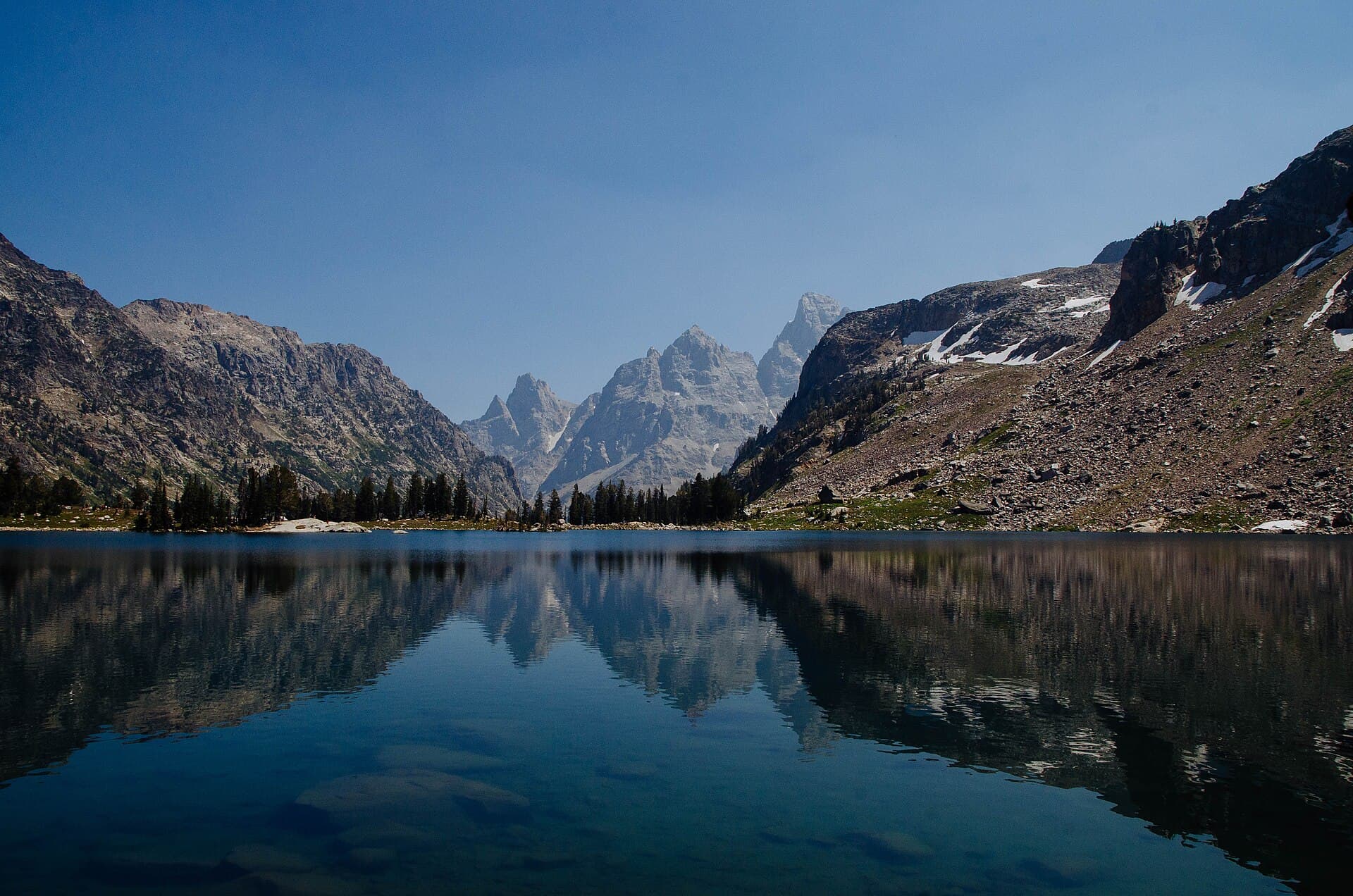
This is the Tetons' signature loop and the reason most people apply for a Grand Teton backcountry permit at all. It links two of the range's biggest canyons over a 10,000-foot divide, passes Holly Lake and Lake Solitude, and puts the Grand, Owen and Teewinot in front of you for most of a day. The park's own note on it is short and telling: this is an extremely busy trail July and August.
The Paintbrush route
- Distance
- 19 miles
- Route type
- loop
- Trip length
- 2-3 days
- Difficulty
- strenuous
Entry points: String Lake, South Jenny Lake
Teton Range. Nearest town: Jackson, WY
Points along the route
- Lower Paintbrush zone
- Lake Solitude
Paintbrush permit detailsandAll Grand Teton National Park permits
The Experience
Up through forest and boulder fields into Paintbrush Canyon, over a divide that is often still holding snow, then down into Cascade with the north face of the Grand filling the head of the canyon. Camp in a zone rather than at a numbered site, which means you pick your own spot inside a marked boundary.
The park publishes the loop as 19.0 miles from the String Lake trailhead, and suggests one night. It does not publish an elevation gain for it, and the only gain figure it gives in that section belongs to the Teton Crest Trail, which is a different route.
Camping is by zone. The relevant ones are Lower Paintbrush, Upper Paintbrush, Holly Lake - which the park describes as three campsites near Holly Lake in Paintbrush Canyon - and, on the far side, North Fork Cascade, described as a camping zone in the North Fork of Cascade Canyon near, but not at, Lake Solitude. South Fork Cascade sits below. Group sites exist separately at Holly Lake, North Fork Cascade and South Fork Cascade. Zones are marked by a sign at each end and you choose your own campsite inside the boundary; campfires are not allowed in any mountain camping area.
The divide is the crux. Recreation.gov's guidance is explicit: safe travel over Paintbrush, Static Peak and Moose Basin Divides, and Hurricane, Mt. Meek and Fox Creek Passes requires an ice axe and knowledge of its use as late as August, and if you are planning to cross any divide before late July without those skills, consider an alternate route. The park's own conditions report on 2026-07-19 had Paintbrush Canyon snow free to Holly Lake, with snow patches higher up and ice axe and crampons advised.
What to Expect
19.0 miles as a loop from String Lake, which the park suggests doing in one night
Zone camping, not numbered sites - pick your spot between the boundary signs
Holly Lake is three campsites; North Fork Cascade is a zone near but not at Lake Solitude
Six people per individual permit; 7 to 12 must use a designated group site
An ice axe and the skill to use it if you cross the divide before late July - and possibly as late as August
Bear canisters required, and free to check out at any permit station
No campfires in any mountain camping area
Get Paintbrush Alerts
Be first to know when cancellations happen.
Permit Requirements
A backcountry permit is required for all overnight camping
Individual permits can consist of up to six people; groups of 7-12 people must camp in designated group sites
IGBC-approved bear canisters are required for food storage in the backcountry
Campfires are not allowed in any mountain camping area
Maximum two nights per location, ten nights between June 1 and Labor Day, and thirty nights per year
Camp inside the marked zone boundary; the signs at each end of a zone define it
Walk-up permits are issued one day before the start date, first-come first-served
Gear & Preparation
Required Gear
- •An IGBC-approved bear canister - free to check out with your permit at any permit station
- •An ice axe, and the knowledge to use it, for any divide crossing before late July
- •A stove; campfires are prohibited in all mountain camping areas
- •Water treatment
- •Wind and rain layers for an exposed 10,000-foot divide
Recommended Gear
- •Crampons or microspikes - the park's 2026-07-19 report advised both for upper Paintbrush
- •Trekking poles for the descent into Cascade
- •Sun protection; the divide has no shade
- •A shelter that handles afternoon thunderstorms
Hazards & Safety
Snow and ice on Paintbrush Divide. The park's guidance is that safe travel over it requires an ice axe and knowledge of its use as late as August
Afternoon thunderstorms on a fully exposed divide
Grizzly and black bears, which is why the canister is mandatory rather than advised
Fire danger listed as HIGH on July 31, 2026
Death Canyon Road and Trailhead closed to all use June 19 to September 7, 2026
Best Time to Visit
Late July through September. Before late July the divide is a snow climb rather than a hike, and the park says as much. September clears the crowds and the snow both, though nights get cold at 9,000 feet. The permit season runs May 1 to October 31.
Pro Tips
Two thirds of Grand Teton's backcountry permits are walk-up. If January 7 does not go your way, showing up the day before is a genuinely good plan here - much better odds than at most parks.
Book Holly Lake if you can. It puts the divide crossing in the morning, which is when the snow is firm and the storms have not built.
Carry an ice axe until you have seen a current conditions report saying otherwise. The park's own line is that the divide can need one as late as August.
The canister is free at the permit station. Do not buy one for this trip.
For 2026, drop the Death Canyon variants from your planning - the road and trailhead are closed to all use from June 19 to September 7.
100+ wilderness permits, extensive backcountry experience
This guide is based on personal experience obtaining wilderness permits and is regularly updated to reflect current policies and strategies.
Frequently Asked Questions
How do I get a Paintbrush permit?
+
Paintbrush permits require advance reservations. Book online as soon as reservations open for your desired dates.
When is the best time to visit Paintbrush?
+
Late July through September. Before late July the divide is a snow climb rather than a hike, and the park says as much. September clears the crowds and the snow both, though nights get cold at 9,000 feet. The permit season runs May 1 to October 31.
How long is the Paintbrush route?
+
The route is 19 miles, as a loop. Plan on 2-3 days.
How difficult is the Paintbrush route?
+
Fit backpackers with snow-travel skills, or anyone willing to wait until the divide melts out in late July or August.
Where does the Paintbrush route start?
+
The permit covers 2 entry points: String Lake, South Jenny Lake.
What gear do I need for the Paintbrush route?
+
Essential gear includes: An IGBC-approved bear canister - free to check out with your permit at any permit station, An ice axe, and the knowledge to use it, for any divide crossing before late July, A stove; campfires are prohibited in all mountain camping areas, Water treatment, Wind and rain layers for an exposed 10,000-foot divide.
Don't Miss Your Paintbrush Permit
Cancellations happen every day. PermitSnag monitors Paintbrush availability 24/7 and alerts you the moment a spot opens up.
Get Permit Alerts