Havasupai Lodge
Rooms in Supai Village, two miles above the falls. Sleeps up to four with privat...
View Havasupai Lodge Reservation permit details and availabilityWe watch this permit around the clock. When a cancellation posts, we send you an alert so you can book before the spot is gone. Pro and $29 single-permit alerts are checked about every minute. Free accounts are checked hourly.

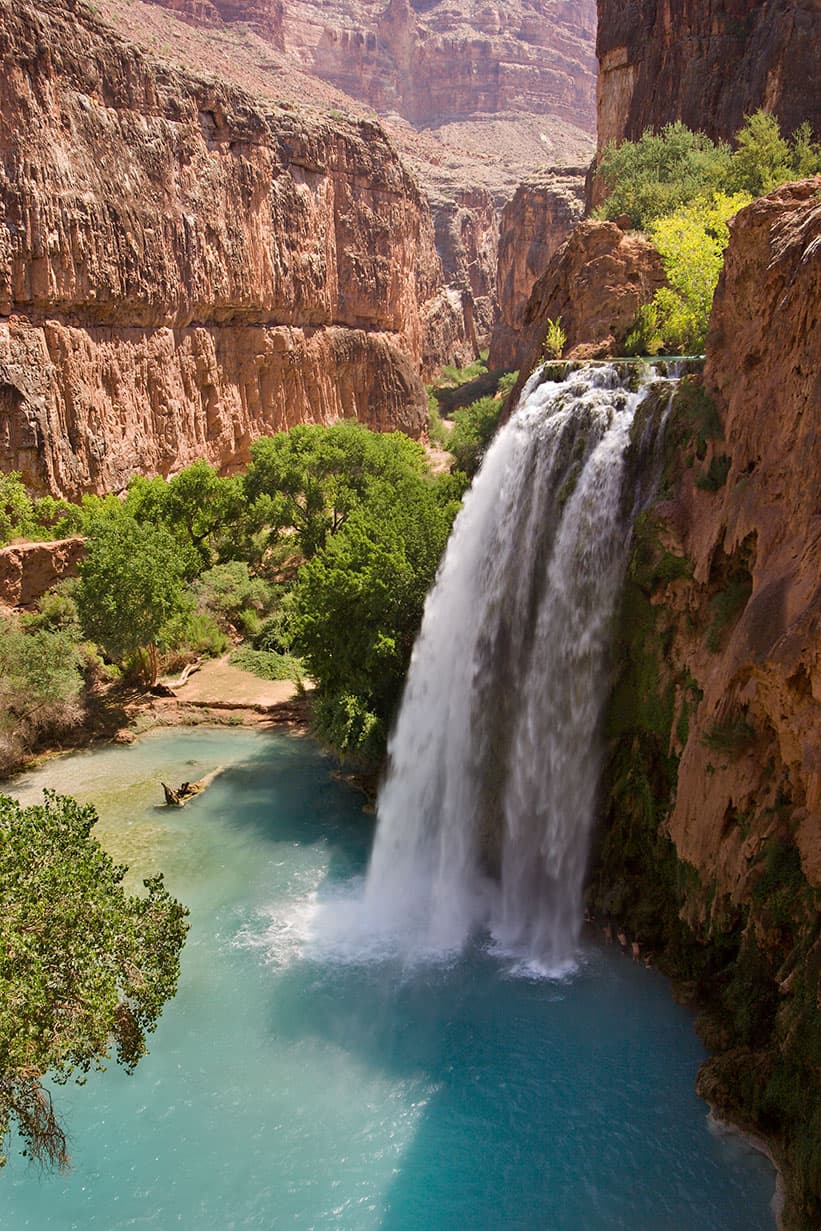
Three nights beside the most famous waterfalls in America. The 10-mile hike to the campground passes Supai Village and ends between Havasu Falls and Mooney Falls, with turquoise water everywhere you look.
“Ten miles down a side canyon of the Grand Canyon to a campground strung between two waterfalls, on land that belongs to the Havasupai Tribe and is booked through nobody but them.”
Watch the dates you'd take— one alert covers all of them
70% of the openings our scanner caught on Enchantments Core Zone were gone within 10 minutes.
The Tribe's own line is that the canyon is worth seeing at any time of year, and that cooler months are better for hiking while warmer months are better for being in the water - as long as you hike in and out early in the day. Peak season is May to September, when Supai can pass 100°F and also drop into the 50s at night. Shoulder months are cold and can snow. July through September is monsoon season, with a real flash-flood risk.
Trailhead (5,000 ft)
Backcountry Tips
Today
105°
73°
Wed
107°
82°
Thu
107°
79°
22%
Fri
100°
76°
53%
Sat
100°
78°
Sun
103°
75°
42%
Mon
102°
79°
28%
Sign up at HavasupaiReservations.com if you don't have an account. Have your payment info ready.
Permits typically release on a rolling basis. Check the specific release time for your desired dates.
Log in a few minutes early. Have your dates, group size, and payment ready to go.
If your dates are sold out, people cancel all the time. Set up PermitSnag alerts to catch openings instantly.
Warming but still manageable on the trail. Cold nights are still possible in the canyon.
Fitness and endurance required
Climbing, scrambling, or specialized skills
Steep dropoffs and fall potential
Route finding and trail clarity
Difficulty of bailing out mid-route
Hikers who can carry a three-night pack 10 miles in desert heat and get themselves back out. The trail is obvious; the difficulty is heat, distance and the fact that nobody is coming to help quickly.
One previous 10-mile day with a full pack, in heat. Add a plan for what happens if someone in your group cannot walk out.
Young children - the Tribe explicitly does not recommend bringing them. Anyone who needs accessible terrain, anyone relying on service animals, and anyone who cannot manage a chain-and-ladder descent should skip Mooney at minimum.
Havasupai is a tribal permit, not a federal one. Every booking is sold by the Havasupai Tribe at havasupaireservations.com, every booking is a fixed 4 days / 3 nights, and campground permits are priced per person - $455 for 2026, including all permits, fees and taxes. A single campground booking can hold up to 12 people.
The hike is 8 miles from Hualapai Hilltop at 5,200 feet down to Supai Village at 3,205 feet, then another 2 miles to the campground. There is no shade and no water for the first 8 miles. The 2026 season went on sale February 1 at 8:00 a.m. Arizona time.
There is no lottery and no transfer board. Reselling or transferring a booking is prohibited outright, and the Tribe enforces it with cancellation and a permanent ban. Cancellations go back through the Tribe: at least 90 days out you get 50% back, and inside 90 days nothing is refundable, which is what puts dates back into circulation through the season. Watching the Tribe's public booking calendar for those returning dates is the only route in after opening day.
This is not a national park permit and it does not behave like one. The Havasupai Tribe is a federally recognised sovereign nation and it sells every permit itself, through its own booking system, under its own rules. There is no lottery, no Recreation.gov, no transfer board, and reselling a booking is prohibited outright. Every visit is a fixed four-day, three-night block, and the Tribe's booking terms are the only rules that apply.
The trail starts at Hualapai Hilltop at 5,200 feet, at the end of Indian Road 18. It drops through switchbacks into the wash and follows it 8 miles to Supai Village at 3,205 feet, where the lodge, the tourist office and the only supplies are. The campground is another 2 miles down the main trail, past Havasu Falls.
The campground itself is an open stretch along Havasu Creek with no assigned sites - the Tribe's description is to pitch anywhere in the designated area. Mooney Falls is at the far end, reached by a chain-and-ladder descent through a travertine tunnel. Beaver Falls is further down; Fiftyfoot and Little Navajo are upstream toward the village.
Walking out is the same 10 miles in reverse with roughly 2,000 feet of climbing back to Hilltop, which is why almost everyone starts before dawn.
The first eight miles are dry, exposed switchbacks and gravel wash with no shade and no water, and then you walk into Supai Village and the creek is suddenly there - the same improbable turquoise in every photo you have seen, running through red rock. Two more miles and you are at the campground, pitched somewhere between Havasu Falls and the top of Mooney. The water sits at about 70 degrees all year, which is the reason people come back.
The only trailhead. 5,200 feet, at the end of Indian Road 18, roughly 60 miles from the Route 66 turnoff.
Tourist parking is separate from the tribal member lot and is limited; overflow parks along Indian Road 18. Register every vehicle's plate at check-in to get a parking pass. RV parking is tight and turning around on the way out can be difficult.
Indian Road 18 is paved but open range - plan at least 1.5 hours for that section. Check in first at Grand Canyon Caverns & Inn.
Nearest gas is 70-90 miles away, in Peach Springs or Seligman. The Tribe advises carrying fuel for at least 200 miles before you start down Indian Road 18.
There is no public transport to the trailhead and no reliable cell reception on the road or in the canyon.
Required and recommended gear for Havasupai Falls
Trailhead transportation options
Browse all shuttlesExperienced wilderness guides
Browse all guidesSome links may be affiliate links. Purchases support PermitSnag at no extra cost to you.
Only from the Havasupai Tribe, at havasupaireservations.com. The 2026 season went on sale February 1 at 8:00 a.m. Arizona time. Every booking is a fixed 4 days / 3 nights, campground permits are $455 per person including all fees and taxes, and one booking can hold up to 12 people.
No. Permits are sold directly by the Tribe on the opening date. There is no lottery and no transfer board, and reselling or transferring a booking in whole or in part is strictly prohibited - the penalty includes cancellation with no refund and a permanent ban from Havasupai.
Through cancellations. The Tribe refunds 50% for cancellations made at least 90 days before your start date and nothing inside 90 days, so people give dates up throughout the season. Those dates go back through the Tribe's own booking system, which is why watching the calendar is the only way in once opening day is over.
$455 per person for 3 nights at the campground, or $2,277 per lodge room for 3 nights covering up to four people. Pack mules are $400 round trip per mule. Children 6 and under are free with a valid permit holder; 7 and older need a paid permit.
8 miles from Hualapai Hilltop to Supai Village, then 2 more miles to the campground - 10 miles each way. Hilltop is at 5,200 feet and the village is at 3,205 feet. There is no shade and no water until you reach the village.
Cancellations must be requested at least 90 days before your start date to get a 50% refund of the permit fee, excluding any early access fee, and each permit has to be cancelled individually. Inside 90 days nothing is refundable, with no exceptions for weather, illness or travel problems.
No. The Tribe does not allow pets, service animals or privately owned horses anywhere on the Havasupai Reservation, including the trail, the campground, the lodge and the village.
No to both, effectively. Most of the reservation has no reliable WiFi or cell reception, including the campground and lodge. There are no public medical facilities in Supai Village and no trained emergency rescue teams; evacuation can take hours or days, costs a lot, and only the injured person goes.
No active conditions reported
Sign in to report trail conditions.
No questions yet
Be the first to ask about Havasupai Falls.
Havasu Falls holds direct light for only a short window mid-morning; the canyon walls take it away early. Mooney is better in flat light because the spray blows constantly.
Overcast is your friend here. The turquoise reads truer without hard sun and blown highlights on the travertine.
Day 2 and day 3 are the busy days at Havasu Falls. Shoot it on your arrival afternoon or your departure morning, and do Mooney and Beaver in the middle of your stay.
Consider these alternatives if your preferred dates aren't available.
Rooms in Supai Village on the same booking system - two miles above the campground, with beds, a private bathroom and no tent to carry.
$2,277 per room for 3 nights sleeping four is about $569 each against $455 for a campground permit - and no tent, pad, stove or food to carry. You are 2 miles above the falls instead of camped between them.
The other famous water-at-the-bottom-of-the-canyon trip: camp beside Bright Angel Creek at the Colorado River, on a national park permit.
A monthly lottery instead of a same-day sellout, and $15 a night instead of $455 for the trip. Different canyon, no waterfalls, and a 4,380-foot climb out.
The corridor crossing on the national park side of the Grand Canyon, 23.5 miles rim to rim.
Far more permit inventory and a monthly lottery you can enter repeatedly. No turquoise water, and you cannot reach the Havasupai Reservation from a park permit - the Tribe requires its own.
Permit Directory
Find permits for day hikes, overnight backpacking, thru-hikes, canyoneering, and river trips across federal and state lands.
Day-use, overnight, and wilderness permits at America's crown jewels
Sierra Nevada, Lost Coast, and backcountry access
Red rock canyons, slot canyon permits, and desert wilderness
USFS wilderness areas with quota systems
Multi-day point-to-point traverses and epic long-distance trails
Multi-day rafting and river access permits
Backcountry camping and trail permits
High-altitude summit permits and technical climbing routes