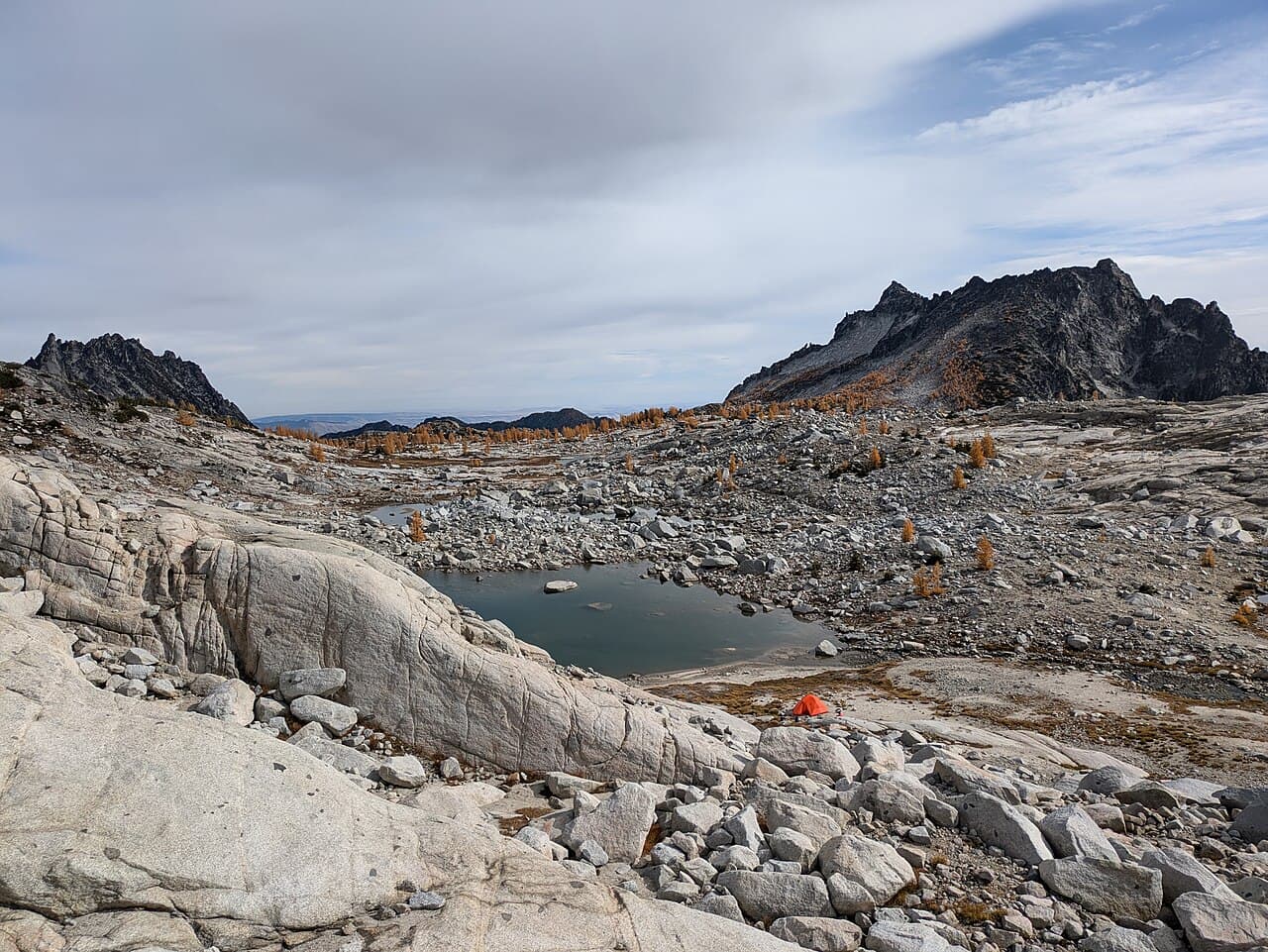
Core Zone Permit: Quota, Dates and Route
Core Zone permits get cancelled and re-released through the season in The Enchantments, and they are drawn by lottery to begin with. The route covers 18 miles.
Twenty-four people a day enter the Core Enchantment Zone - the high lake basin between Aasgard Pass and Upper Snow Lake, and the hardest overnight permit in Washington to draw.
This guide covers the Core Enchantment Zone permit.
Under 10% (USFS, all zones)
Lottery Odds
24
People Per Day
$6 lottery application + $5 per person, per day
Permit Cost
2-4 days
Duration
18 miles
Distance
About Core Zone
The Enchantment Permit Area sits inside the Alpine Lakes Wilderness in Washington's Cascade Mountains - rugged glaciated peaks and a chain of lakes ranging from 4,400 to 7,800 feet. The Forest Service is blunt about the trails: "Although the area is high use, trails are very primitive with steep, rocky sections. Travel is difficult in areas." The Core Enchantment Zone is the hardest of the five zones to get into, and the quota is written in people rather than groups. A total of 24 visitors may enter the Core Zone per day. Sixteen of those spaces come from the advanced lottery held each February; the remaining eight come from the daily lottery, which runs May through October and requires you to be inside a geofenced area near Leavenworth to apply. Group size tops out at eight, and once the advanced lottery is done your group size cannot be increased. Permits are required for overnight stays from May 15 through October 31. The rest of the year no permit is needed, though the Forest Service asks visitors to self-register at the trailhead box.
The Core is the one zone whose quota is written in people rather than groups, which tells you how tightly the Forest Service holds it. Sixteen of the 24 daily spaces come from the February advanced lottery and eight from the daily lottery. Everything about the permit is designed around the fact that the basin is small, the vegetation is fragile, and demand for overnight permits far exceeds the number available.
The Core Zone route
- Distance
- 18 miles
- Route type
- point-to-point
- High point
- 7,826 ft
- Low point
- 1,370 ft
- Trip length
- 2-4 days
- Difficulty
- expert
Entry points: Stuart Lake Trailhead, Snow Lakes Trailhead
Alpine Lakes Wilderness, Cascade Mountains. Nearest town: Leavenworth
Points along the route
- Stuart Lake TrailheadMile 0, 3,399 ft
- Colchuck LakeMile 4.2, 5,500 ft
- Aasgard PassMile 5.2, 7,826 ft
- Tranquil & Isolation LakesMile 6.5
- Core Enchantment ZoneMile 7, 7,208 ft
- Inspiration LakeMile 8
- Perfection LakeMile 8.5
- Prusik PeakMile 8.5
- Leprechaun LakeMile 9.5
- Lake VivianeMile 10, 6,800 ft
- Upper Snow LakeMile 11.5, 5,433 ft
- Snow LakesMile 13
- Nada LakeMile 14.5
- Snow Lakes TrailheadMile 18, 1,370 ft
The Experience
Getting here costs you something either way. From Colchuck the route climbs very steeply on loose rock; from Snow Lakes it goes up bedrock slabs that ice over without warning. Then it levels out and you are in a basin of pale granite and lakes with larches scattered through it, and there are at most 23 other people in the whole zone. You set the tent on rock, not vegetation, and watch the goats work the slabs.
The Core Enchantment Zone is the high lake basin between Aasgard Pass and Upper Snow Lake. The Forest Service describes two routes in. The first begins at the Stuart Lake Trailhead and travels past Colchuck Lake - 4.2 miles and 2,100 feet on the Colchuck Lake Trail - then climbs very steeply to Aasgard Pass on loose rocky terrain. The second begins at the Snow Lakes Trailhead, climbing 6.5 miles and 4,100 feet to Upper Snow Lake, then ascending slabs of bedrock that can be treacherous if icy.
Once you are in, travel is on an unmaintained route often marked only by cairns, and the Forest Service asks visitors to take care not to trample sensitive vegetation. The lakes across the permit area range from 4,400 to 7,800 feet.
One rule makes the trip far more manageable than it looks: because of the long and arduous approach, groups holding a Core Zone permit may camp in any of the other zones on their entry or exit. That turns a brutal single push into a staged trip.
What to Expect
A quota counted in people, not groups: 24 visitors enter the Core Zone per day
Two ways in, both hard - Aasgard Pass from Colchuck Lake, or bedrock slabs above Upper Snow Lake
Unmaintained route within the Core, often marked only by cairns
Lakes between 4,400 and 7,800 feet, with snow and winter-like conditions possible in May, June, September and October
Fragile alpine vegetation that the Forest Service asks you not to trample
A Core Zone permit that also lets you camp in any other zone on your entry or exit night
Get Core Zone Alerts
Be first to know when cancellations happen.
Permit Requirements
Overnight permits required May 15 through October 31; the rest of the year self-register at the trailhead box
A total of 24 visitors may enter the Core Zone per day - 16 through the advanced lottery, 8 through the daily lottery
Eight people is the maximum group size allowed at any time, and group size cannot be increased after the advanced lottery
Because of the long approach, a Core Zone permit lets you camp in any other zone on your entry or exit
The permit is valid only for the exact dates and the specific zone printed on it
Once a reservation is made, the permit zone and entry date cannot be changed
No dogs permitted
No campfires above 5,000 feet or within half a mile of any lake
Use toilets where provided
Day users need a free self-issued day-use permit from any of the three trailheads, plus a Northwest Forest Pass, parking in the designated day-use areas at the Stuart Lake Trailhead
A maximum of 14 days can be reserved on one permit
Gear & Preparation
Required Gear
- •Water filter or treatment - the lakes are the only supply
- •Rain gear and insulation for weather that turns winter-like in the shoulder months
- •Boots with real edges for the loose rock on Aasgard and the slabs above Upper Snow Lake
- •Sun protection for sustained time above treeline
- •A way to secure food from goats and rodents overnight
Recommended Gear
- •Trekking poles for the Aasgard descent and the boulder fields
- •Microspikes or an ice axe early and late in the season, when the slabs above Upper Snow Lake ice up
- •Camp shoes for wading and snow crossings
- •A wag bag as backup where no toilet is provided
Hazards & Safety
Aasgard Pass - very steep, loose rocky terrain with no maintained trail
The Snow Lakes approach ascends bedrock slabs the Forest Service warns "can [be] treacherous if icy"
Route-finding within the Core, where the way is unmaintained and often marked only by cairns
Afternoon thunderstorms with no shelter above treeline
Snow and winter-like conditions in May, June, September and October
Mountain goats habituated to people around camps
Best Time to Visit
Mid-July through mid-September is the reliable snow-free window. The Forest Service treats May, June, September and October as shoulder seasons where you should expect snow and winter-like conditions, so a late-September larch trip is a real gamble on weather as well as on the lottery.
Pro Tips
Apply for every zone you would actually accept - the Core is the hardest draw of the five
The Snow Zone takes five groups a day, the most of any zone, and lets you day hike the whole Core
Enter the daily lottery too - it holds 8 of the Core Zone's 24 daily spaces, but you must be inside the geofence to apply
Unclaimed lottery awards go back to the advance reservation system on April 1 around 7am PT
Set your group size carefully on the application; you cannot add anyone after the lottery
A Core permit lets you camp in another zone on the way in or out, which makes the approach far more manageable
Day hiking needs only the free self-issue permit at the trailhead
100+ wilderness permits, extensive backcountry experience
This guide is based on personal experience obtaining wilderness permits and is regularly updated to reflect current policies and strategies.
Frequently Asked Questions
How do I get a Core Zone permit?
+
Two ways. Cancelled Core Zone permits return to the booking system through the season, and PermitSnag alerts you the moment one opens. The other way is the lottery, so apply during the application window as well.
When is the best time to visit Core Zone?
+
Mid-July through mid-September is the reliable snow-free window. The Forest Service treats May, June, September and October as shoulder seasons where you should expect snow and winter-like conditions, so a late-September larch trip is a real gamble on weather as well as on the lottery.
How long is the Core Zone route?
+
The route is 18 miles, as a point-to-point. Plan on 2-4 days.
How difficult is the Core Zone route?
+
Experienced backpackers comfortable carrying a full pack up loose rock and following a cairned route across bedrock.
Where does the Core Zone route start?
+
The permit covers 2 entry points: Stuart Lake Trailhead, Snow Lakes Trailhead.
What if I don't win the Core Zone lottery?
+
Cancelled permits return to the booking system through the season. PermitSnag watches Core Zone and alerts you when one opens, so a lost draw is not the end of the trip.
Don't Miss Your Core Zone Permit
Cancellations happen every day. PermitSnag monitors Core Zone availability 24/7 and alerts you the moment a spot opens up.
Get Permit Alerts