Lottery10/10
JMT permit
The legendary 211-mile trail from Yosemite Valley to Mount Whitney. Two Donohue ...
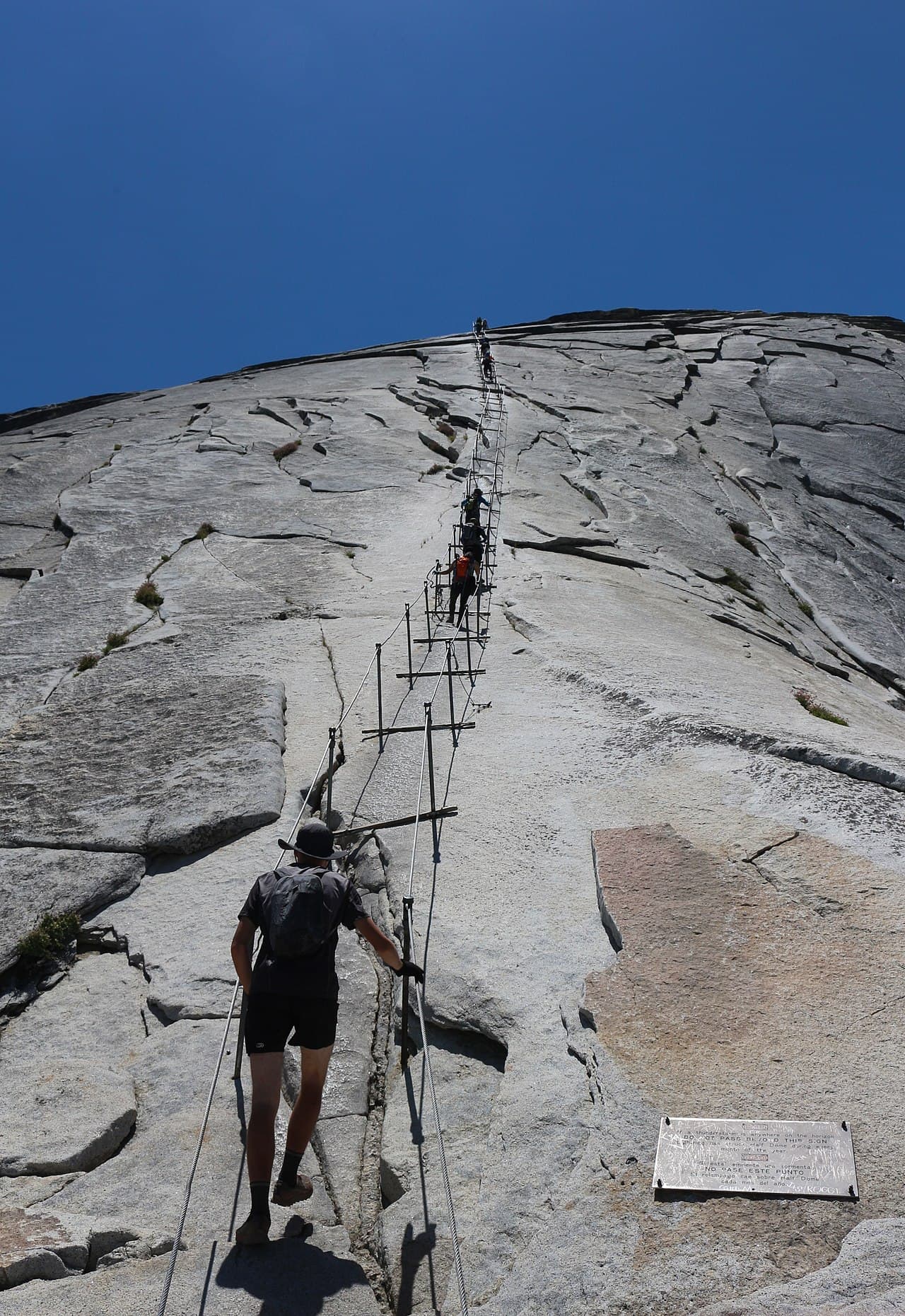
Required permit to climb the famous cables on Half Dome. One of the most sought-after day hikes in America.
“Stand atop one of America's most iconic granite monoliths, 4,800 feet above Yosemite Valley floor.”
Half Dome is issued by the agency rather than through a booking calendar. Their page has the current process and any dates.
Official permit pagePlanning another trip? See the permits we watch.
Half Dome is issued by the agency rather than through a booking calendar. Their page has the current process and any dates.
Official permit pagePlanning another trip? See the permits we watch.
Two ways to land it
We remind you when the Half Dome lottery opens, before the deadline, and when results post, so you never miss your window. This permit is awarded by lottery, so there are no cancellations to catch.
Set lottery remindersApply with a crew. Each person multiplies your combined odds (solo ~22% preseason (NPS, 2024)). We coordinate invites, deadlines, and outcomes.
See plans to start a poolBest odds: run a pool and let us remind you before every deadline.
Build your full itinerary start to finish
Add your dates and get a day-by-day plan: what needs a permit, what gear to bring, and one link to share with your whole group to coordinate every step.
No permit needed to start
Source: National Park Service, Yosemite National Park. Read the official permit page.
“The application period for this lottery is from March 1 through March 31 (eastern time).” Published under the heading "Preseason Lottery".
Checked against the agency page on August 20, 2026.
Late June through early September offers the most reliable conditions. July and August have warm temperatures but also afternoon thunderstorm risk. September has fewer crowds and stable weather but shorter days.
Trailhead (4,035 ft)
Backcountry Tips
Today
58°
45°
Mon
60°
44°
Tue
65°
39°
Wed
63°
35°
Thu
62°
35°
Fri
63°
35°
Sat
67°
41°
Sign up at Recreation.gov if you don't have an account. Verify your email and add payment info ahead of time.
Submit your application between March 1 and March 31. Apply for multiple dates to increase your odds.
Results are typically announced Mid-April. Check your email and your Recreation.gov account.
Cables typically down. Waterfalls spectacular but snow may block upper trail.
Fitness and endurance required
Climbing, scrambling, or specialized skills
Steep dropoffs and fall potential
Route finding and trail clarity
Difficulty of bailing out mid-route
Well-conditioned hikers comfortable with significant exposure and heights. Must be able to maintain grip strength for the 400-foot cable ascent.
Should have completed at least one 10+ mile, 3,000+ ft elevation gain hike. Prior cable or scrambling experience helpful but not required.
Those with fear of heights, limited upper body strength, or anyone who has not completed a strenuous 10+ mile hike before.
Half Dome is one of the most demanding day hikes in any National Park—a 14 to 17-mile round trip that climbs nearly 5,000 feet from the valley floor to the summit at 8,846 feet. The hike passes two of Yosemite's most spectacular waterfalls before ascending the granite shoulder of Half Dome itself.
The final 400 feet are ascended using steel cables bolted into the rock, allowing hikers to climb what would otherwise require technical rock-climbing gear. This cable section is only accessible when the cables are 'up,' typically from late May through mid-October.
Half Dome has been a symbol of Yosemite since the park's founding. Its distinctive shape—carved by glaciers over millions of years—has inspired artists, photographers, and adventurers for over 150 years. For many, summiting Half Dome represents a personal milestone and a connection to the wilderness vision of John Muir.
From Happy Isles, the trail splits into two paths that reunite above Nevada Fall. The Mist Trail is shorter but brutal—600 granite stairs rising through the spray of Vernal Fall, each step more slippery than the last. The John Muir Trail switchbacks more gently, offering views of Liberty Cap's granite dome.
Above Nevada Fall, the forest closes in as you traverse Little Yosemite Valley. The crowds thin as you climb through silent pine forests toward the shoulder of Half Dome. Then the trees fall away, and you see it: the Sub Dome rising like a wall, and beyond it, the cables ascending into the sky.
The Sub Dome's steep switchbacks are merely a prelude. The cables themselves stretch 400 feet up polished granite at a 45-degree pitch. You grip cold steel, plant your feet on wooden planks, and pull. Pause. Breathe. Pull again. And then, suddenly, you're standing on top of the world.
The final ascent up the cables is unlike anything else in hiking. Your arms burn as you pull yourself up the 45-degree granite face, pausing at each wooden plank to catch your breath and steady your nerves. The exposure is intense—a sheer drop on either side with nothing but your grip and the steel cables between you and a very long fall. But when you crest the summit and step onto that broad granite dome, the entire Sierra stretches before you in an infinite sea of peaks and valleys.
The primary and most popular starting point for Half Dome, located at the eastern end of Yosemite Valley at Shuttle Stop #16.
No direct parking at trailhead. Use the Half Dome Village day-hiker lot (0.5 miles) or Curry Village (0.75 miles). Lots fill by 7am on summer weekends.
Take the free Yosemite Valley shuttle to Stop #16. Shuttles run every 12-22 minutes from 7am to 10pm.
Half Dome Village (Curry Village) has a general store, showers, and dining 0.75 miles from the trailhead.
Better odds with a crew
Half Dome is a lottery — solo odds run about 22%. Every friend who applies adds another entry. Five of you, each applying: about 71%.
One of you runs the pool (Pro or a $19 alert). Everyone else joins free.
Required and recommended gear for Half Dome
Trailhead transportation options
Browse all shuttlesExperienced wilderness guides
Browse all guidesSome links may be affiliate links. Purchases support PermitSnag at no extra cost to you.
22% preseason (NPS, 2024)
estimated success rate
Get detailed lottery statistics and tips. Sign up to track this permit.
Apply with a crew to multiply your combined odds, and let auto win-detection tell you the moment you win — you never have to check Recreation.gov. Win-detection reads the result email you forward us, so it takes a one-time setup in your inbox (about two minutes, and we walk you through it). Pool and auto win-detection are on Pro or a $19 permit alert.
Apply these for the best odds
Opens the official lottery — you submit your entry. We never automate or store your Recreation.gov login.
Full lottery odds & strategy →Emergency contacts, ranger station locations, and satellite communicator tips for Half Dome.
Bear canister requirements, approved container lists, and rental locations for this permit.
Yes, whenever the cables are up, seven days a week. NPS caps the trail beyond the base of the subdome: "A maximum of 300 hikers are allowed (about 225 day hikers and 75 backpackers) each day on the Half Dome Trail beyond the base of the subdome." Rangers check permits at the bottom of the subdome, and the permit holder or the named alternate has to be standing there with the group.
The preseason lottery runs March 1 through March 31 eastern time, with results emailed in mid-April. After that there is a daily lottery all season: you apply two days before you want to hike, between midnight and 4 pm Pacific, and hear back late that night. NPS says the daily permits exist "based on the estimated rate of under-use and cancellation of permits," so the number floats day to day.
NPS publishes this one, unlike its wilderness trailheads. For 2024 the park reports 35,289 preseason applications and a 22% application success rate, the same as 2023. The daily lottery ran 35,561 applications at a 19% success rate, splitting to 22% on weekdays and 14% on weekends. Note the preseason weekday and weekend numbers are counted differently: those are per-choice rates, 1.0% and 0.8%, not per-application.
Two separate charges. $10 when you submit the application, which is per application and not per person, and is not refundable. Then $10 per person, charged only if you actually get the permit. That second $10 is fully refundable if you cancel by 11:59 pm Pacific the day before your hike, or if the cables are not up on your date.
Six. NPS allows "up to six permits (six people)" on one preseason application. A person's name can appear on only one application in the preseason lottery, as either permit holder or alternate, and applying more than once cancels all of your applications. Daily lottery applications allow a permit holder only, with no alternate.
"The Half Dome cables usually go back up the Friday before the last Monday in May (Memorial Day) and come down the day after the second Monday in October." Both dates move with conditions, so check the park's status page before you count on them. If the cables are not up on your date, your $10 per-person fee comes back.
NPS calls it 14 to 16 miles round trip with 4,800 feet of gain, and "most hikers take 10 to 12 hours to hike to Half Dome and back; some take longer." The last 400 feet are the cables. Park rangers assist hundreds of people on this trail every summer, and the park is blunt that the hike "is not for you if you're out of shape or unprepared."
Yes, and through a different door. Backpackers, including anyone camping in Little Yosemite Valley, request Half Dome with their wilderness permit rather than through the day-hiker lottery. If your permit is for a Half Dome eligible trailhead you add it when you pick the permit up, no advance reservation, $10 per person. One catch from NPS: start your JMT hike outside Yosemite and finish inside it, and your permit is not valid for Half Dome.
Sunset from Glacier Point offers the most iconic Half Dome photography, with alpenglow turning the granite face pink, orange, and red.
Midday light on the summit provides even illumination for the 360-degree panorama. For the classic Ansel Adams view, shoot from Valley View at sunrise with Merced River reflections.
For summit photography, arrive by first light (5am start) or stay until the last shuttle—midday crowds thin significantly after 2pm on the summit.
Consider these alternatives if your preferred dates aren't available.
A 14.5-mile hike with a knife-edge summit ridge that offers views looking DOWN on Half Dome from 1,000 feet above. Many argue the views are superior to Half Dome itself.
No cables or permit hassle, but requires Tioga Road access (seasonal). Less crowded but equally strenuous.
A 10-mile hike offering face-to-face views of Half Dome from directly across the valley. Includes optional side trip to Indian Rock natural arch.
Much less crowded and no permit needed, but you're looking at Half Dome rather than standing on it.
A 13-16 mile valley-rim loop passing Glacier Point and three major waterfalls (Illilouette, Nevada, and Vernal Falls).
No permit required and spectacular waterfall views, but no summit experience.
Nearby campgrounds to complete your Half Dome trip
Articles that plan a trip around this permit.
A small favor
Google lets you pick the sites it highlights for you. Add PermitSnag and our permit pages get marked as one of yours in AI Overviews and AI Mode.
Takes less than a minute.