Compare
Mt. St. Helens climbing permit
Both are Cascade climbing permits: Mount Rainier is drawn by lottery and Mount St. Helens is first-come.
Mount Rainier National Park · Washington
Climbing permit for Mount Rainier via all routes. Requires annual climbing fee plus wilderness permit for overnight climbs.
70% of the openings our scanner caught on Rainier were gone within 10 minutes.
Build your full itinerary start to finish
Add your dates and get a day-by-day plan: what needs a permit, what gear to bring, and one link to share with your whole group to coordinate every step.
No permit needed to start
May 1 through September 15 is what NPS calls the peak climbing season, and it lines up with staffed ranger stations at both high camps. Camps fill fastest on Friday nights and weekends, so a midweek start is the easiest way to improve your odds. In 2026 reservable dates run to October 12.
Rainier
Trailhead (5,400 ft)
Backcountry Tips
Today
37°
32°
Tue
34°
30°
32%
Wed
53°
29°
Thu
58°
37°
Fri
51°
32°
Sat
55°
32°
Sun
56°
33°
Sign up at Recreation.gov if you don't have an account. Verify your email and add payment info ahead of time.
Submit your application between February 10, 2026 (early-access lottery, 7 a.m. PT) and March 3, 2026 (7 p.m. PT). Apply for multiple dates to increase your odds.
Results are typically announced March 14, 2026. Check your email and your Recreation.gov account.
Permits get cancelled daily. Peak cancellation times are 24-48 hours before the trip date.
Get notified when cancellations happen. Pro and $19 single-permit alerts are checked about every minute, 24/7; free accounts are checked hourly.
The permit season turns over. Winter self-registration runs to May 21, summer walk-up registration starts May 22, and the wilderness permit season NPS calls "peak" begins May 1.
Fitness and endurance required
Climbing, scrambling, or specialized skills
Steep dropoffs and fall potential
Route finding and trail clarity
Difficulty of bailing out mid-route
Experienced mountaineers comfortable with Class 3-4 terrain and altitude.
Glacier travel training required. Must be competent with crampons, ice axe, and rope work.
Those without high-altitude experience. Altitude sickness is a serious risk above 10,000 ft.
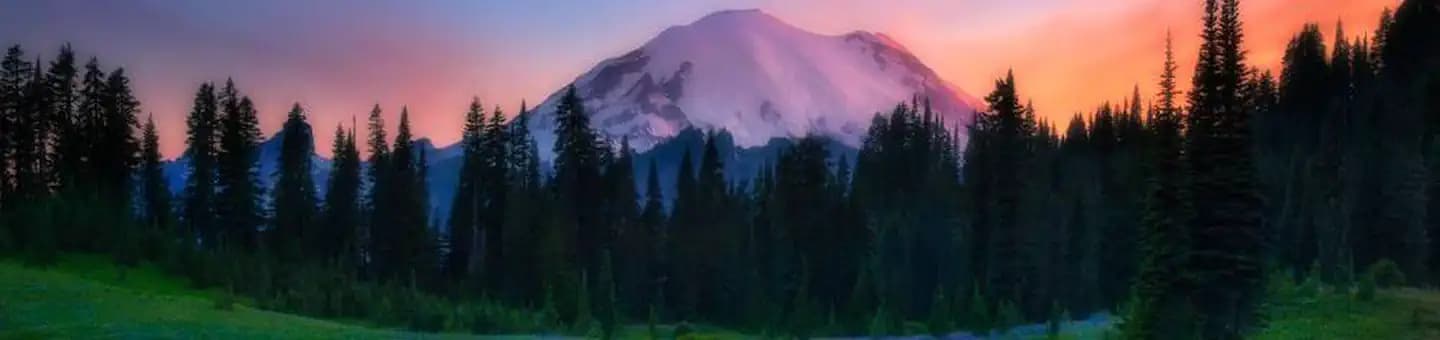
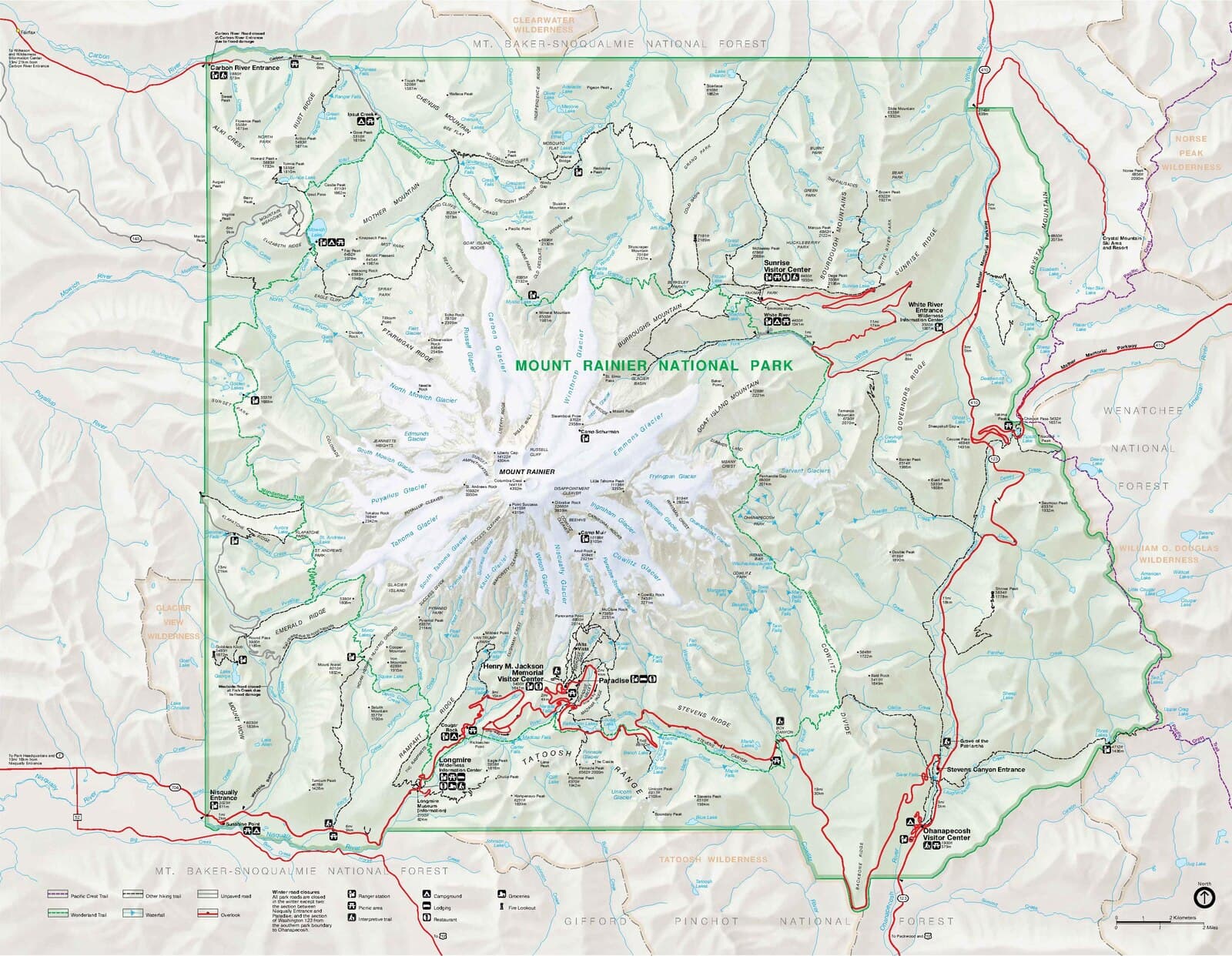
Mount Rainier is a 14,410-foot active volcano and the most heavily glaciated peak in the contiguous United States. NPS says reaching the summit by any route takes a vertical gain of more than 9,000 feet over ten or more miles, and that technical glacier-travel rope skills are required. There are over twenty climbing routes reached from four main trailheads — Paradise, Westside Road, White River and Mowich Lake — though SR165 to Carbon River and Mowich Lake is currently closed with no alternate route.
The permitting is layered, and which layers apply depends on when you go. Federal regulation requires a permit to be on a glacier or above roughly 10,000 feet, requires climbers to be 18 or have a guardian's permission, and prohibits soloing without specific authorization. From September 15 to May 21 you self-register: pay $82 per person at Pay.gov before you arrive, then fill out a card at the kiosk at the Paradise Old Station, and in winter that card also serves as your wilderness permit. From May 22 to September 30 there is no self-registration — you register in person at a wilderness information station, and the park holds roughly half of capacity at each camp and zone for walk-ups available 24 hours before the climb.
On top of climbing registration, the high-use season from May 1 to September 15 requires a wilderness permit at $12 per person per night, even if you are not camping and are climbing in a single push, because the park manages use along the whole route. Roughly two thirds of summer permits are reservable in advance on Recreation.gov and the remaining third are walk-up. An optional early-access lottery exists because demand for the Wonderland Trail and high-use climbing routes exceeds capacity: in 2026 it opened February 10, closed March 3, notified applicants March 14, and gave winners staggered booking windows from March 21 before general on-sale on April 25.
About success rates: NPS does not publish one any more. Its annual climbing statistics stop reporting the number of climbers who summited after 2018, the last figure being 5,135 successful out of 10,762 climbers, or 47.7%. No current NPS page gives a per-route success rate.
The south-side approach and the start of the Disappointment Cleaver route via Camp Muir. One of the four main trailheads NPS names for reaching the mountain.
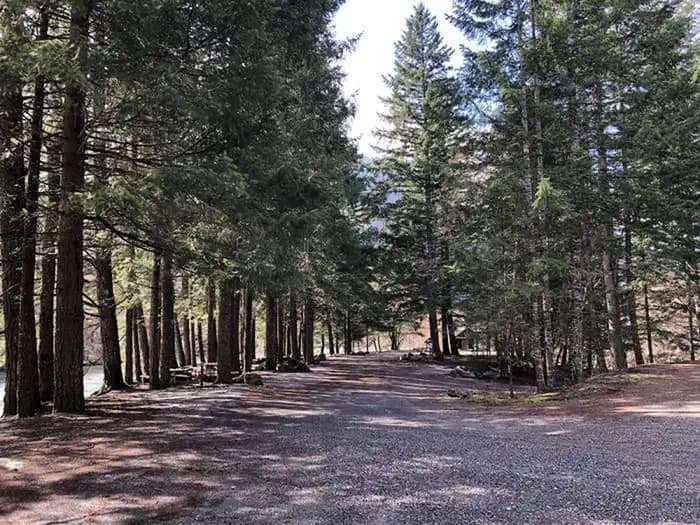
Large lot at the Henry M. Jackson Visitor Center. In winter, the self-registration kiosk is inside the awning of the Paradise Old Station — the small A-framed building at the edge of the parking lot across from the visitor center.
From the Nisqually entrance near Ashford. The Paradise Wilderness Information Center — formerly the Climbing Information Center — processes wilderness permits in summer; the Jackson Visitor Center does not.
Longmire has the Longmire Museum and the Longmire Wilderness Information Center. Ashford, outside the Nisqually entrance, has the nearest full services. Wilderness permit questions: 360-569-6650.
The east-side approach and the start of the Emmons-Winthrop route via Camp Schurman. NPS publishes a full route brief for this line.
Permits are issued at the White River Wilderness Information Center at the White River Entrance. In winter, self-register at the SR410 entrance arch at the park's north boundary.
Off SR410 on the northeast side of the park. Note that SR165 to Carbon River and Mowich Lake is closed until further notice because of the Fairfax Bridge closure outside the park, with no alternate route, and that As of August 9, 2026 the park lists Sunrise Road and White River Road to the campground as CLOSED due to the Grand Park 2 Fire until further notice — so three of the four main trailheads were not usable on that date. Check the park road status page.
Enumclaw and Crystal Mountain are the nearest services on the SR410 side.
Lottery concierge
Next season’s application dates aren’t published yet.
We check for them every day. Track Rainier now and your concierge picks them up the moment they land, then emails you when applications open, before the deadline, and when results post.
Better odds with a crew
Rainier is a lottery. Every friend who applies adds another entry, so a crew gets more shots at the same permit than any one of you alone.
One of you runs the pool (Pro or a $19 alert). Everyone else joins free.
Required and recommended gear for Rainier
Trailhead transportation options
Browse all shuttlesExperienced wilderness guides
Browse all guidesSome links may be affiliate links. Purchases support PermitSnag at no extra cost to you.
The high camp on the south side. NPS lists a ranger station, a solar toilet and the Muir Public Shelter, which holds about 25 people first come, first served. Climbers melt snow for water here and treat or boil it.
Alternative high camp below the Disappointment Cleaver, out on the Ingraham Glacier.
The east-side high camp on the Emmons-Winthrop route. NPS lists a ranger station and a solar toilet, and the same melt-and-treat water situation as Camp Muir.
The summit of the most heavily glaciated peak in the contiguous United States. NPS says reaching it by any route takes more than 9,000 vertical feet and over ten miles of travel.
Competitive
estimated success rate
Get detailed lottery statistics and tips. Sign up to track this permit.
Apply with a crew to multiply your combined odds, and let auto win-detection tell you the moment you win — you never have to check Recreation.gov. Win-detection reads the result email you forward us, so it takes a one-time setup in your inbox (about two minutes, and we walk you through it). Pool and auto win-detection are on Pro or a $19 permit alert.
Guides recommended for first-time climbers. Find authorized guide services.
Authorized guide services:
Don't own technical gear? Find rental shops near the trailhead.
Required gear you can rent:
Real-time route status, snow levels, and climbing conditions.
Current conditions include:
Check avalanche conditions before winter and spring climbs.
Avalanche info includes:
48% in 2018 — 5,135 of 10,762 attempts, the last year NPS counted summits
summit success rate
Based on ~9,530 annual attempts
It depends on the season. From September 15 to May 21, pay $82 per person at Pay.gov before you arrive and then self-register at the kiosk inside the awning of the Paradise Old Station; in winter that card also serves as your wilderness permit. From May 22 to September 30 there is no self-registration — pay the $82 online, then register in person at a wilderness information station. Between May 1 and September 15 you also need a wilderness permit at $12 per person per night, which you can reserve on Recreation.gov or get as a walk-up 24 hours before your climb.
NPS no longer publishes one. Its Annual Climbing Statistics table records the number of climbers and the number successful from 1950 through 2018 and then footnotes the later years "Number successful no longer collected." The last published pair is 2018: 5,135 successful out of 10,762 climbers, or 47.7%. Recent climber counts are 9,138 in 2021 and 9,530 in 2022, with no success figures attached. Any per-route percentage you see quoted for Rainier is not an NPS number.
No — NPS calls it optional. It exists because demand for the Wonderland Trail and high-use climbing routes exceeds capacity, and winning it buys you an earlier booking window, not a permit. In 2026 it opened February 10 at 7 a.m. PT, closed March 3 at 7 p.m. PT, notified applicants on March 14, and opened staggered access from March 21. Everything left goes on general sale April 25 at 7 a.m. PT. Lottery participants can make only one reservation during the early-access period.
Yes. NPS holds roughly 50% of capacity at each camp and in each wilderness zone for walk-up registration during the summer season, and you can register for a walk-up 24 hours before your climb at a Wilderness Information Center. The fee is $12 per person per night plus the non-refundable $6 reservation fee, credit or debit only, no cash. NPS advice is still not to rely on it: camps fill quickly, especially on Friday nights and weekends.
Not without specific authorization. 36 CFR 7.5(b)(3) requires a party of at least two people unless you get a solo permit, which is reviewed against your experience, the anticipated weather and conditions, and the route. NPS says roughly 200 people apply to solo Rainier each year and fewer than half receive permits — and that while it denies wilderness permits and climbing registrations only in the rarest cases, solo permits get much more scrutiny.
$82 per person for climbing registration, paid at Pay.gov before you arrive. On top of that, a wilderness permit at $12 per person per night for up to 13 consecutive nights, plus a $6 non-refundable Recreation.gov reservation fee if you book in advance. Walk-up permits cost the same $12 per person per night plus the $6 fee, and are credit or debit only.
Twelve people. NPS also sets a floor: a minimum of two people is required, a team of three is better able to effect a rescue or get help, and for winter climbs a minimum of four is recommended.
No active conditions reported
Sign in to report trail conditions.
Summit bids start in the small hours, so most parties top out around sunrise with the mountain's own shadow thrown west across the Cascades. That is the shot, and it is a byproduct of the climbing schedule rather than something you plan for.
Evening at Camp Muir or Camp Schurman, when the light goes long across the glaciers and you are stationary and warm enough to work a camera. On the route itself you are roped and moving in the dark.
The Emmons-Winthrop route from White River is the standard alternative to the Disappointment Cleaver and NPS publishes a full route brief for it. Weekends and Friday nights fill camps fastest, so a midweek start is the single easiest change to make.
Consider these alternatives if your preferred dates aren't available.
Washington's second-highest volcano, with a climbing pass rather than the layered Rainier permit stack.
Far less crevasse hazard on the standard route and a much simpler permit, but it will not prepare you for glacier travel the way Rainier does.
A permitted volcano climb with no glacier travel and no rope work.
A conditioning day rather than a mountaineering objective. Good for testing fitness and gear before a Rainier attempt.
Rainier's east-side standard route via Camp Schurman at 9,460 feet, with its own official NPS route brief. Same summit, same permit, different trailhead.
Longer approach from White River and less traffic than the Disappointment Cleaver, with more crevasse navigation and less rockfall.
Nearby campgrounds to complete your Rainier trip
A small favor
Google lets you pick the sites it highlights for you. Add PermitSnag and our permit pages get marked as one of yours in AI Overviews and AI Mode.
Takes less than a minute.